%20(1).svg)
Know the cost and tradeoffs of your AWS Workload - existing & future
Modern FinOps starts too late - at deployment, after decisions are locked.
The OpsPilot shifts cost left by learning how cloud cost behaves in your environment - so current spend becomes explainable and future decisions become predictable.
Closed Alpha - Limited Design Partner Access
What is The OpsPilot?
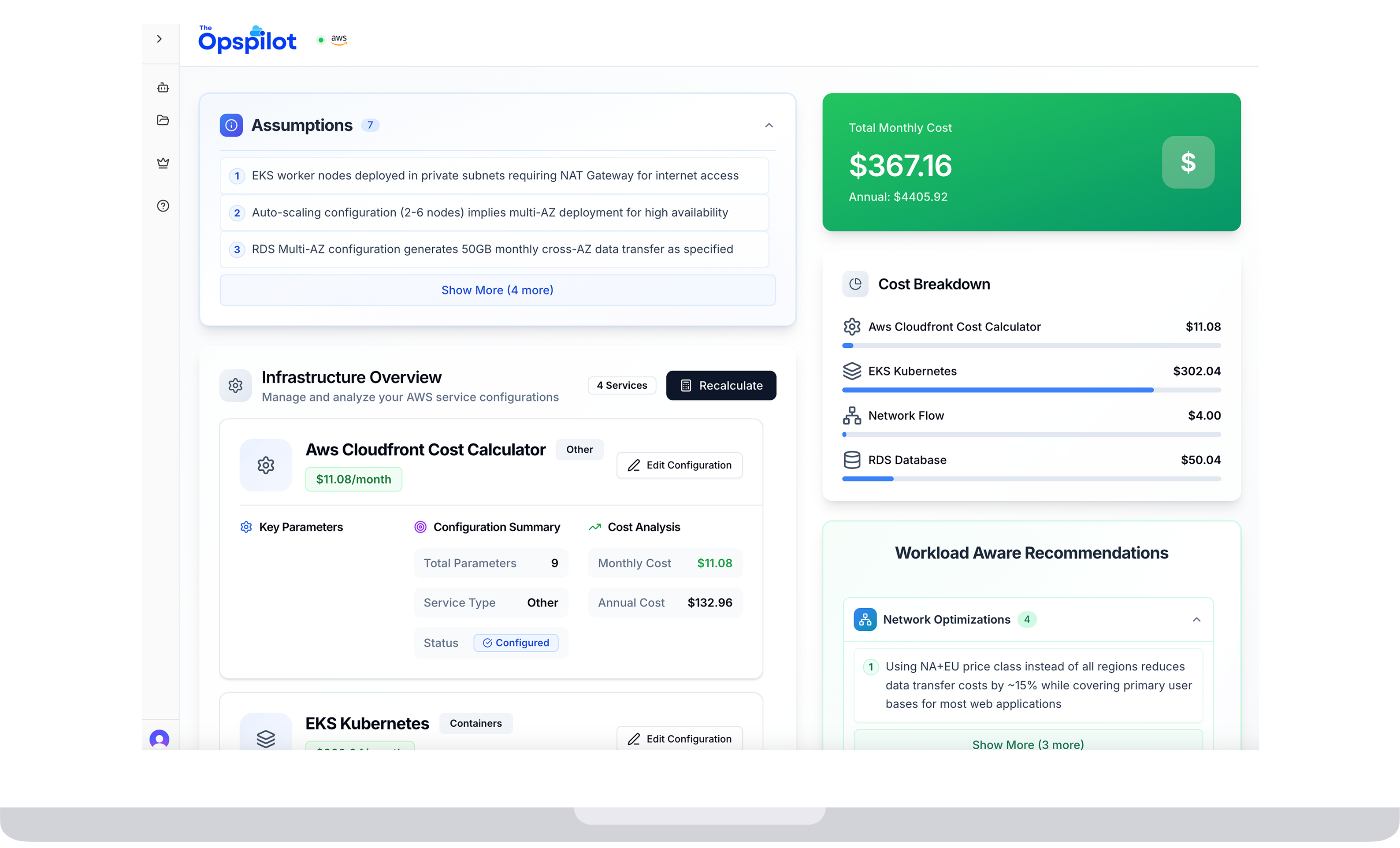
The OpsPilot models how cloud cost behaves in your environment, so both current spend and future decisions become explainable and predictable.
It is a predictive FinOps platform that starts by analyzing your existing AWS infrastructure to explain current cost drivers, then uses those learned behaviors to generate credible planning-stage cost estimates for future workloads.
TOP learns how your organization actually builds and runs systems - instance families, network patterns, availability choices, and storage defaults - and uses those signals to model realistic architectures, surface cost drivers, and make tradeoffs explicit.
Once workloads are deployed, TOP compares reality against architectural assumptions, detects drift in cost behavior, and continuously guides optimization as environments evolve.

FinOps Tools starts too late - after architectural behavior has already formed and cost patterns are locked in.
No cost visibility at planning
Pricing calculators don’t understand workloads
Engineers don’t use external tools
.svg)
- Is this workload costing $500/month or $50,000/month today, and why?
- Is this comparable to our other running workloads?
- Are we accidentally gold-plating the design or carrying legacy assumptions forward?
By bounding expectations early, TOP prevents the most expensive failure mode in cloud:“We thought this would be cheap.”

- Default design: $4.8k/month
- Cost-optimized: $2.1k/month
- High-availability: $8.9k/month
This forces a real decision:
Which option are we choosing and why?
Cost stops being a hidden consequence of architecture and becomes an explicit tradeoff.

TOP continuously learns from how your existing workloads actually run - traffic patterns, scaling behavior, defaults, and usage - and feeds those learnings back into both optimization and future planning.
TOP helps teams understand:
- Which architectural assumptions are driving cost today
- Where reality diverged from expectations and why
- Which defaults or patterns silently inflated spend over time
- What would change the cost curve most if redesigned
By grounding decisions in observed behavior, optimization becomes targeted, not reactive or speculative.

Once workloads are live, TOP compares real usage against modeled behavior - detecting drift, surfacing optimization levers, and refining future cost scenarios.
This creates a continuous loop:
- Current environments become explainable
- Future estimates become more accurate
- Tradeoffs get sharper with every iteration
FinOps stops being a reporting exercise and becomes a learning system, improving with every workload you run.

Understand → Plan → Design → Operate TOP stays with you across the full lifecycle.
Step 1: Understand
TOP :
- Analyzes how cost behaves across your current AWS workloads
- Identifies dominant cost drivers tied to architecture, defaults, and usage
- Explains why spend looks the way it does, not just where it went
- Establishes a behavioral baseline from real systems
Value: Existing spend becomes explainable. Cost behavior becomes predictable
Step 2: Plan & Design
TOP :
- Uses learned cost behavior to model realistic architectures
- Generates planning-stage cost ranges, not false precision
- Surfaces explicit tradeoffs (availability, performance, cost)
- Applies org-specific defaults instead of generic calculators
Value: No blind commitments. Tradeoffs are explicit before work starts.
Step 3: Operate
TOP :
- Compares real usage against modeled assumptions
- Detects drift in cost behavior and architecture
- Surfaces targeted optimization opportunities
- Feeds learnings back into future planning
Value: Continuous efficiency without slowing velocity.
Access & Engagement Model
During alpha, teams engage through a guided process to validate predictive cost models against real AWS environments and provide feedback that shapes product direction.
.svg)