%20(1).svg)
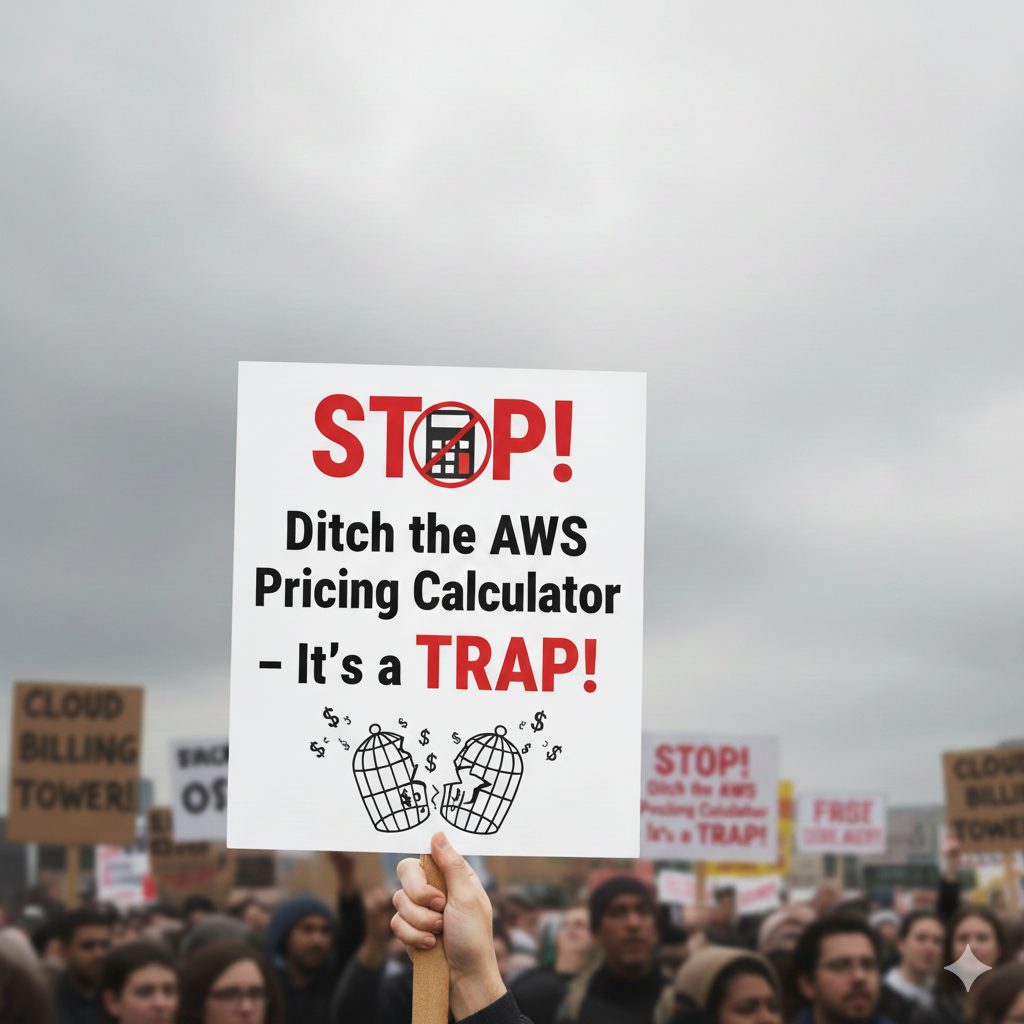
Why Your AWS Pricing Calculator Is Lying to You

Why Your AWS Pricing Calculator Is Lying to You
Because It Has No Knowledge of Your Environment
Most teams use the AWS Pricing Calculator with the right intent. They estimate a few services, get a monthly number, and feel confident that cost has been “accounted for.”
Then the workload goes live and the bill tells a very different story.
This isn’t because the calculator is inaccurate. It’s because it operates without the one thing real cloud cost depends on:
environment and workload context.
The Core Limitation
The AWS Pricing Calculator is environment-agnostic and workload-agnostic.
It has no visibility into:
- your AWS organization
- what’s already running
- how infrastructure is shared
- how traffic flows today
- how workloads actually behave
It must assume isolation because it lives outside your environment but AWS costs are never isolated.
Every new workload lands inside:
- existing VPCs
- shared NATs
- shared clusters
- shared data paths
The calculator cannot see any of this yet your bill reflects all of it.
Why Estimates Diverge in Predictable Ways
Once you accept that the calculator has no org or workload context, the common “surprises” stop being mysterious.
Scaling isn’t unknown - your scaling is
The calculator doesn’t lack knowledge of autoscaling.
It lacks knowledge of your autoscaling behavior.
It doesn’t know:
- how often your ASGs scale
- how long scaled instances live
- whether scaling is bursty or sustained
- how scale amplifies network, logging, and request costs
You can enter min/max values, but that says nothing about distribution over time.
Cost is driven by behavior, not configuration.
Data movement isn’t expensive - unseen data movement is
AWS network costs explode when:
- traffic crosses AZs
- traffic flows through NATs instead of endpoints
- services fan out under load
The calculator cannot infer:
- where traffic actually flows
- what percentage traverses which path
- which interactions dominate volume
Those answers only exist inside your environment.
Over-provisioning isn’t a mistake - it’s a blind default
The calculator assumes you already know:
- correct instance families
- realistic utilization
- growth patterns
Most orgs don’t because utilization varies by workload and team.
Without historical or org-specific signals, conservative sizing becomes the default.
At scale, conservative defaults dominate cost.
Service pricing isn’t wrong - service-centric thinking is
The calculator prices services independently.
AWS bills for:
- interactions
- amplification
- retries
- fan-out
- data movement
These costs emerge from systems, not individual services.
A service-level estimator cannot model system-level behavior.
This Isn’t a Feature Gap, It’s a Model Boundary
The calculator isn’t missing knobs.
It isn’t outdated.
It isn’t broken.
It is bounded by its design:
An isolated estimator cannot reason about a connected system.
No amount of additional inputs changes that.
What Cost-Aware Architecture Actually Requires
Real cost awareness requires:
- workload intent
- org baselines
- scaling behavior
- interaction paths
- behavioral modeling over time
Not after deployment.
During design.
This is not a pricing problem.
It’s a context and systems reasoning problem.
Where TOP Fits
AWS pricing calculators answer:
“What does AWS charge per unit?”
TOP exists to answer:
“What will this workload cost in our environment, given our behavior, our scale, and our architecture — before we commit to it?”
Not a better calculator.
A different level of reasoning.
Final Takeaway
The AWS Pricing Calculator isn’t lying maliciously.
It’s answering a question that ignores the single thing cloud cost depends on most:
context.
And without context, estimates will always diverge from reality — no matter how careful the inputs look.
Cost-aware architecture starts when cost is modeled as a property of systems, not line items.
.svg)
Your May Also Watch

Heading 1
Heading 2
Heading 3
Heading 4
Heading 5
Heading 6
Lorem ipsum dolor sit amet, consectetur adipiscing elit, sed do eiusmod tempor incididunt ut labore et dolore magna aliqua. Ut enim ad minim veniam, quis nostrud exercitation ullamco laboris nisi ut aliquip ex ea commodo consequat. Duis aute irure dolor in reprehenderit in voluptate velit esse cillum dolore eu fugiat nulla pariatur.
Block quote
Ordered list
- Item 1
- Item 2
- Item 3
Unordered list
- Item A
- Item B
- Item C
Bold text
Emphasis
Superscript
Subscript
Heading 1
Heading 2
Heading 3
Heading 4
Heading 5
Heading 6
Lorem ipsum dolor sit amet, consectetur adipiscing elit, sed do eiusmod tempor incididunt ut labore et dolore magna aliqua. Ut enim ad minim veniam, quis nostrud exercitation ullamco laboris nisi ut aliquip ex ea commodo consequat. Duis aute irure dolor in reprehenderit in voluptate velit esse cillum dolore eu fugiat nulla pariatur.
Block quote
Ordered list
- Item 1
- Item 2
- Item 3
Unordered list
- Item A
- Item B
- Item C
Bold text
Emphasis
Superscript
Subscript